Monday, 4 February 2013

Mood Board

04/02/13
Mood Board For Our Target Audience


I have created a ‘Mood Board’ for “Me, Myself and I” that helps to show the different target audiences that will be attracted to our film.
Our mood board consists of several pictures which we think best represents our target audience. Because our film uses a wide variety of genres, our target audience is quite spread out and can include almost everyone. Our largest, main picture represents the multiple-personality disorder and shows how our target audience largely consists of people who have been touched by this disability. If it has played a massive part in someone’s life, they are likely to be attracted to our film and this is the reason why they would be our primary target audience. However, there are other aspects to our film, such as the picture in the top left that shows a girl being bullied. This represents the fact that our protagonist is an underdog and is affected by gossip and bullying throughout the story. This links with the top right picture that presents devastation or sadness. This underdog theme occurs repeatedly throughout our film and so our target audience may include people who have been affected by bullying as they can relate to the character of May. The picture of books in the bottom right symbolises school and the fact that the majority of our target audience will most likely be female teenagers (students in education) because our film is all about the life of a teenager and a 17 year olds journey. Finally, we have the picture to represent drama at the top of the mood board which is there to show how people who enjoy drama and suspense will be attracted to our film; therefore being included in the target audience. Our film includes lots of drama as May struggles to handle her disability and get through school. Overall, our target audience includes a variety of people as we include a variety of genres. Because of this, our film is suitable for almost anyone, although our real primary audience will be those who are affected by DID as they will sympathise with the character and story most and teenage girls as they will connect with the protagonist.

Monday, 21 January 2013

Casting

AB - 21/01/13
 
Our Casting Decisions for Our Opening Scene


Vita Oldershaw as May Stanwell

Vita Oldershaw is a British actress, voice artist and Dancer. She has played Hermia and Puck in separate productions of A Midsummer Night’s Dream, Betty in Oliver and Queen Cole in The Mummer`s Play. Her film work includes educational English language videos and voice-overs for Immersive Education.

She played the lead, Dorace Damour in Heavenly Mane a short film which went to Cannes film festival (2010) directed by Oscar Oldershaw. She is also currently appearing in the feature film World War Z by Paramount pictures starring Brad Pitt, due to be released 2013.
Vita is a very competent dancer, having danced in professional operatic productions and at the Oxford Playhouse and Pegasus theatre. Her recent credits include dancing in Resolution! (2012) at The Place.

http://www.firstvoiceagency.com/vita_oldershaw.php
http://www.secondskinagency.com/profiles/tv_film_theatre/vita_oldershaw.htm

http://vimeo.com/13976756


Tamsin Heatley as Jackie Willis (Therapist)
Tamsin Heatley

British actress and voice artist Tamsin Heatley has played roles in several popular drama series including Eastenders, Cracker, Casualty and The Bill. Her latest role was as Petula in the theater version of Dinner ladies. She has also been heavily involved in children’s television. Recent work includes Dirk Gentley`s Holistic Detective Agency for Radio 4, The mum in ITV’s Horrid Henry, and Little Bo in The Roly Mo show.
Other TV includes the role of Bella in the BBC’s BAFTA Award Winning Show The Tweenies, the voice of Baby Pom and Bessie in BBC’s The Fimbles and playing Grandma Baalwen in the Baaas for S4C. She also has numerous theatre credits to her name including plays at the West Yorkshire Playhouse, numerous productions with Theater de Complicite and Lumiere and Son.
http://www.tamsinheatley.co.uk/

http://www.imdb.com/name/nm1052583/

http://www.firstvoiceagency.com/tamsin_heatley.php


http://www.secondskinagency.com/profiles/animatronics_puppeteers/tamsin_heatley.htm

Giles Oldershaw as the mistaken business man

Giles is an accomplished and versatile character actor, voice artist and Artist. His considerable experience covers mainstream drama productions including David Copperfield, Vanity Fair and The Mushroom Pickers and feature films, such as Shadowlands, directed by Sir Richard Attenborough, Dinotopia and Agatha Christie`s Marple. His most recent work includes Nulepsy a short film and the feature film World War Z by Paramount pictures starring Brad Pitt, due to be released 2013.

Giles has also appeared in a variety of commercials: Midland Bank; Woolwich; Mc Ewan lager; Shreddies; Qualcast Lawnmowers; National Lottery Instants; BP & British Gas.

Giles is extremely experienced in Theatre working for many companies including Lumiere and Son.

http://www.imdb.com/name/nm0646110/
http://www.secondskinagency.com/profiles/animatronics_puppeteers/giles_oldershaw.htm

http://www.gilesoldershaw.co.uk/artwork/
Jasmine Gothard plays Girl 1 in Sammy's scene
Daisy Brunston plays Girl 2 in Sammy's Scene


Shooting Schedule

AB - 21/01/13
Shooting Schedule
 
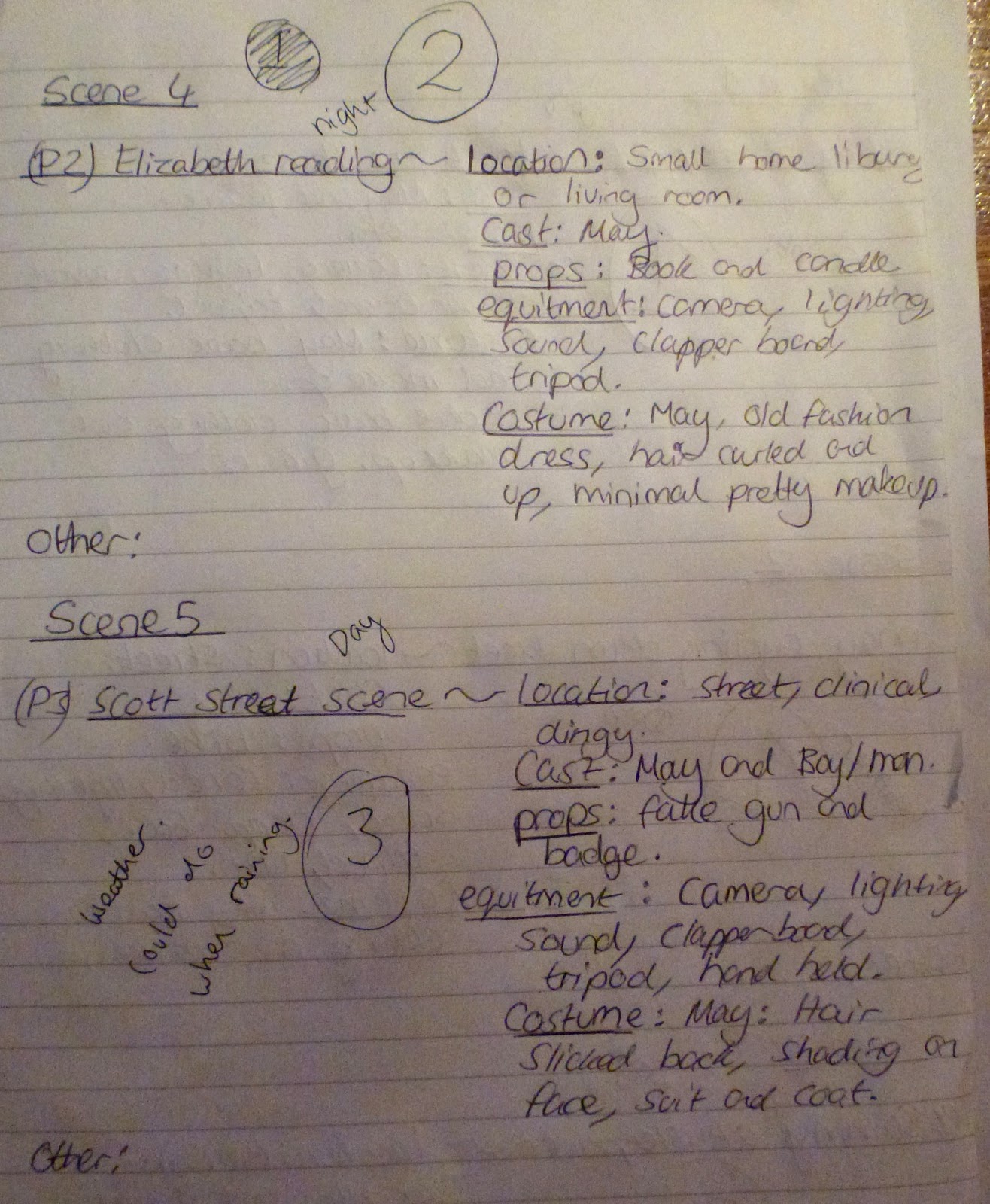
We had a few changes due to changes in the availability of the cast and crew:


Sound in Opening Scenes

AB - 16/01/13
Sound in Opening Scenes

We recorded a timeline for the opening to Kung Fu Panda, including all of the sound effects, volume and tempo changes and voice overs. Only a few of the sounds were really needed to tell the story (mainly the voice overs) but every bit of sound used helped to create an atmosphere and present the action, comedy genre across to the audience.


We then created a timeline for our own opening sequence, adding in the different sounds that we intend to include when we come to the editing stage.


Sunday, 13 January 2013

Analysis of Our Opening Scene

AB - 13/01/13

Analysis of Our Opening Scene
 
 
Mise-en-scene
Camera Work
Differences in costume – represents different personalities.
Different settings/locations – represents different moods.
Lighting
Sammy’s room made pink – childish, safe, happy.
Elizabeth – candlelight, warm, old fashioned (fireplace).
Scott – natural, cold daylight.
May – artificial lighting (compared to Scott).
Close up on eyes to switch scenes – shows that she is the same person, even if her personality is different.
Hand-held camera for Scott – shaky movements connote aggressiveness? Fear/determination as he is running after someone.
Dolly used – Smooth and calm movements
Editing
Sound
Flashbacks.
Fading into different scenes.
 
Scott – Different accent
Sammy – laughing, crying
Slow, sad background music to signify her misery with the DID


Our opening scene represents disability through the use of mise-en-scene, camera work, editing and sound. Firstly, the fact that each ‘personality’ uses a different costume shows how different they really are, and that DID can be quite extreme in some cases when it comes to the separate personalities. This is emphasised through the different locations and settings – used to represent the moods of each character. The mood is also shown through the use of lighting, with Sammy’s room being made pink to connote safety, happiness and childhood. Elizabeth’s scene is made to look warm and old-fashioned with the fireplace and dim lighting. Scott is filmed outside, and so the lighting is natural and more cold compared to the others. Similarly, May’s scenes are presented in a more natural light, but can appear more artificial compared to Scott. All of this mise-en-scene helps to portray disability in quite a harsh way with the different lights, costumes and settings, showing how difficult and confusing this person’s life can be because of DID. The camera work is used in multiple ways to show disability. To switch scenes from May to Sammy, there is a close up on the actor’s eyes and the scene changes although the eyes stay in the same place. This close up is used to show how, although the personality is different, it is still the same person. The hand-held camera for Scott is shaky and creates a more realistic feel, perhaps connoting aggressiveness as he is chasing someone and makes the scene feel argent. This camera work is completely different from the other scenes, once again showing how dramatically the personalities change. Dolly shots are used for the other scenes, making the movements calm and smooth (as the other characters are less active than Scott). Reaction shots of the therapist are used to show how other people respond to this character’s DID and constantly reminds the audience that this disability is so great that she needs to see a therapist regularly.
Flashbacks are used in the editing to switch scenes and to show how May is remembering her week. Fading will also be used to establish continuity editing. The background music for May while she is speaking with her therapist will be slow and calm connoting sadness and how she is miserable with her DID. Scott is presented with a different accent than the other personalities and Sammy is heard giggling and crying – both of these different sounds are used to separate the different personalities, once again reminding the audience about May’s disability and how serious it really is. Therefore, the mise-en-scene, camera work, editing and sound are used to present the character’s disability and shows the audience what kind of life-changing affect it can have on someone.    
 
We have not finished our opening scene yet, and therefore our final analysis is not finished. This is the reason for the lack in editing and sound.


Monday, 17 December 2012

Genre

AB- 17/12/12
Genre of Our Film
 
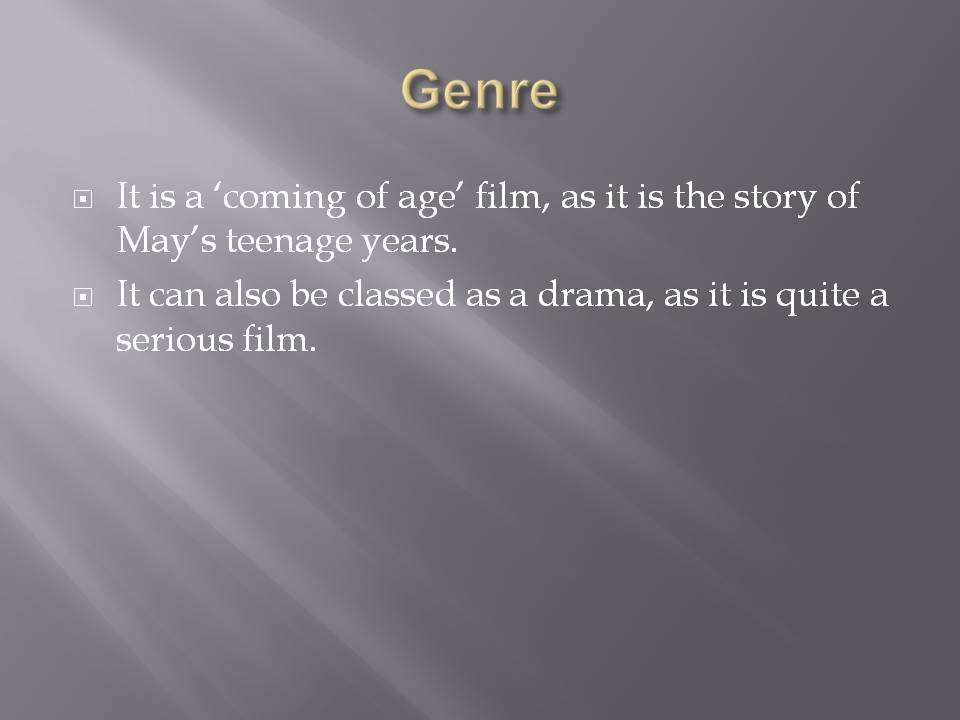
Our film cannot be classed as one specific genre, but is a mix of 'coming of age’, comedy, romantic and serious drama. The serious narrative takes us into this dramatic genre as the subject of DID can by upsetting to some. You could say that our film offers a ‘comforting reassurance’ as the ending is quite happy, resolves the situation and ‘closes down the complexities of life’. There is a constant feel throughout the film that ‘May’ is going to completely humiliate herself by changing into one of her alter-egos, which is eventually resolved in the end.There would be a relationship with the audience, as everyone is able to sympathise with the main character, especially if they have had experience with multi-personality disorders before in their lifetime. Just like ‘squeaking’sounds are associated with horrors, sad and slow music will be used in our film to emphasise the dramatic and upsetting experiences that ‘May’ has had to go through. The audience’s expectations would be that ‘May’ recovers from her disorder or that some resolution is made between her and her parents. These things may well happen, and therefore this would equal pleasure for the audience. There are many dramatic twists, such as the relationship between‘May’ and her best friend which help to associate the genre as drama, along with other complications that may occur.

Final Film Proposal

Ab - 19/11/12
Final Film Proposal

Me, Myself and I
Synopsis
The story revolves around 17 years old May Stanwell, who just like every teenager in the world, is trying to figure out who she is. The only difference is that she unlike the others suffers from a multiple personality disorder. We follow her life through highs and lows as she wrestles with the various personalities that gets in her way. The story builds to the climax of her important interview for University, where her other persona's are determined to destroy her future.
Plot
May Stanwell is a 17 years old student who’s full of potential. She was just a typical girl who belonged in what seemed like a normal family until she was diagnosed with DID (Dissociative Identity Disorder) at the age of 11. May grew up in care of her mother (Holly) as her father (Nick) was a member of the British Royal Navy. The distance between the couple already proved to be a challenge and when May’s condition came into the scene it caused further strain on her parents which resulted to them getting a divorced. From the divorce Statement of Arrangements and 1989 Children’s Act, both parents agreed that May will live with her father as her mother was required to leave the country due to her job and because May already had an existing life in Oxford. Despite the past where Nick was often away, he had a strong bond with his daughter that’s why when asked who she wished to be with, she requested for her dad. This of course was honoured by the court. As a result it had her farther quitting the force and had him looking for a new occupation that will provide for him and May and still allowed him to look after her.

May’s condition flared up when she turned 14, right after her mum had gotten re-married. Consequently, the developments of her multiple personalities affected her social life, losing one friend at a time. Though she was not completely alone as her childhood friend Darren Harring stayed loyal to her. May became an outcast and Darren took the fall with her.
In present time, May is at her final year of sixth form and is doing well. She has a stable life and managed to form new friendships. She had also developed 4 personalities who are completely different from one another. May had also found herself a therapist who she meets often with to help her overcome her disorder. The situation took for the worse when her mother came back to Oxford with her new family, her episodes became more frequent and was getting out of control. This affected her studies, her grades started to drop just when she received an invitation for an interview to one of her chosen Universities. The interview was a disaster. All 4 of her persona have made an appearance in the interview jeopardising her future. Along with this main dilemma, May goes through many challenges such as:
1.      Having multiple dates for prom (one for each personality)
2.      Her condition threatening to ruin her social life yet again
3.      Difficulty of adjusting to her mother’s return and forming relationship with her step-siblings

And many more!
As May’s situation continues to deteriorate, Jackie Willet (May’s therapist) started to invest more and more time analysing May’s case. One therapy session Jackie ended up talking to one of May’s persona instead of May herself. Jackie ended up talking to Sammie (May’s alter ego who’s a young girl). Jackie learns that May as child was abused Holly’s lover. Careful not to make any assumptions, Jackie looked through Holly’s lovers past- Benjamin Cooper who was reportedly been abusive and had a restraining order from a woman called Fiona Carter, previously named as Fiona Cooper; Benjamin’s previous wife.
One evening May engages into a heated argument with her mother where she confronts her about abandonment (May was actually poorly taken care of by Holly) when her dad was in the Navy and demanded why her mother was back. May, in limbo, runs away and ends up in a park where Darren finds her. He counsels May as she reveals her anxieties and Darren professes his love for her. Darren expected May to return his feelings but quite the opposite happens. May was angered by this as it made her further confused about her true identity and storms off.
After the following events, May refused to talk to anyone, even her therapist. Holly went to meet with Jackie to check on her progress. As May’s still underage, Holly and Nick had the right to know about her conversation with Jackie. Jackie talks about her findings about Benjamin Cooper and how it might be related to May’s condition. Jackie confronts Holly if Benjamin had ever been violent around her to which Holly admitted that she had been enduring domestic violence. May, Nick and Holly then attend a therapy where May finally admits of being abused and some resolution is met. Holly ends up taking her case of being abused by Benjamin to court where he was found guilty as his own children testified against him. May gradually recovers and at first was reluctant to saying goodbye to her persona's but eventually does. She receives another invite for an interview from another university where she‘s accepted.
May goes to university and the relationship between her parents becomes friendly. Darren remains friends with her and she continues to live her life.
 
Length of Film:
 
We are a small production company and do not have alot of money to invest in a long film. Therefore, our film will be approximately 1 and a half hours long and will be based in Oxford.
 
Genre and Target Audience:
 
This is a 'coming of age' film but can also be classed as a drama, as the plot is quite serious.
Our target audience is mainly teenagers as the film is based around a teenage character. However, any age group could watch and enjoy it, as many people have probably had passed experiences with DID and can relate to the story.
 
 
More detail, such as May's personalities and other character descriptions are included in the PowerPoint (Pictures) below:


Storyboard


This storyboard shows the sketches for the characters and how we are planning on filming our opening scene, discribing the different camera angles and shots that we may use. This is only a draft however, and may be changed when we actually start filming.